Fencing in Macclesfield
In Macclesfield's farmland the landscape overlay doesn't require a planning permit for a post and wire fence under 1.8 m, and asks about almost everything else.
We connect you with a local fencer who works in the hills.
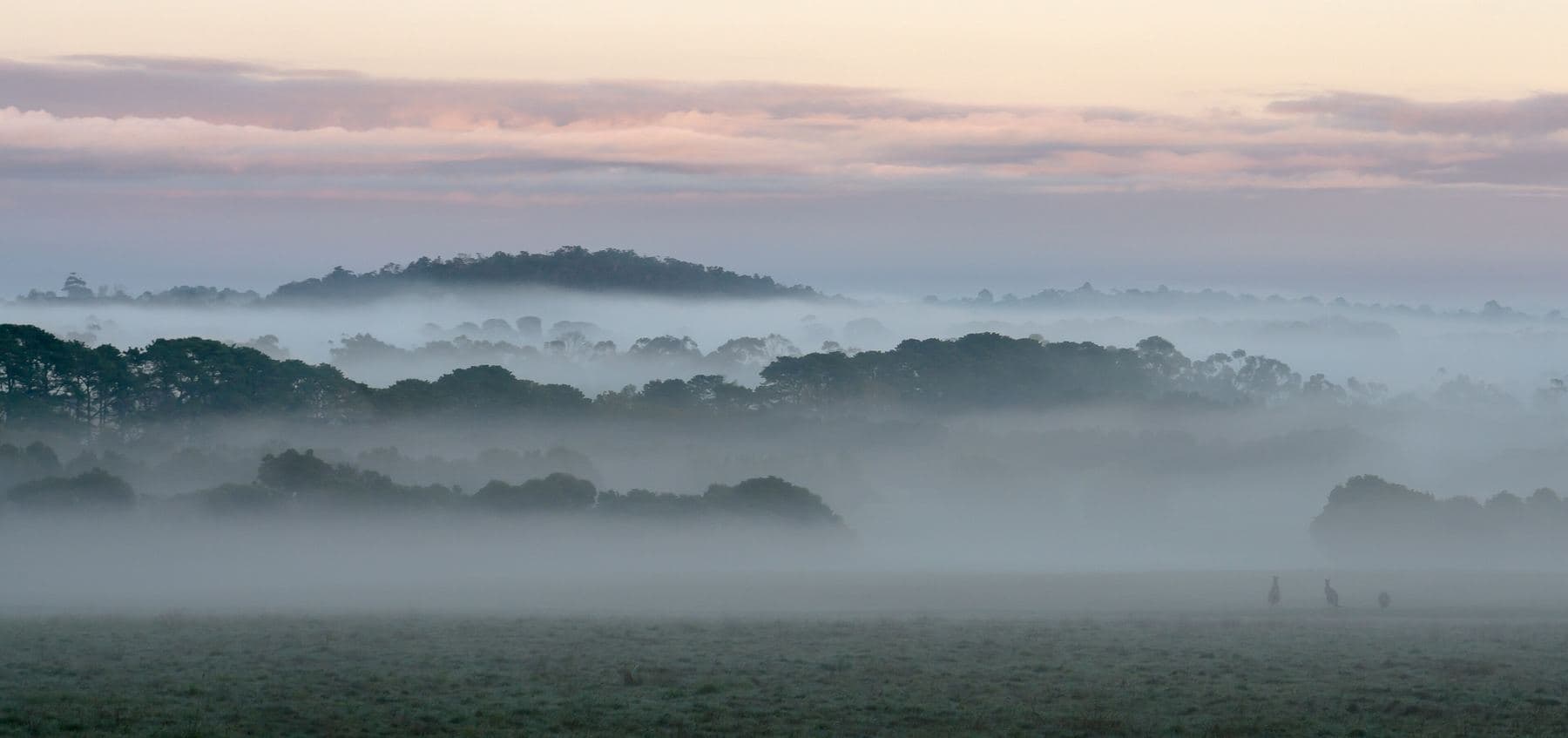
Ask for a quoteDandenong Ranges. Photo: Uzman Naleer, CC BY-SA 4.0

Post and wire is the fence SLO6 expects
Macclesfield is farm country: nearly nine tenths of it is Green Wedge, and none of it is zoned for suburban housing. The whole locality is under a Significant Landscape Overlay, and here that is Yarra Ranges' SLO6, the schedule for its rolling farmland. Under SLO6 any fence needs a planning permit unless it is a rural post and open-weave wire fence under 1.8 m. A paddock fence of posts and ringlock needs none. A sheet-steel or paling fence around a house paddock is a permit question, front, side or back.
A free VicPlan property report confirms the schedule on your land.
Checked 25 October 2026 against Vicmap Planning, the state's zone and overlay maps (DataVic), measured across the suburb and Yarra Ranges Planning Scheme, Schedules to Clause 42.03 (SLO1–6, SLO22, SLO23).
Goats, alpacas and dividing fences
The soil here grows flowers and potatoes, and the town is known for its goats and alpacas. Between two farms the Fences Act's sufficient fence is the farm standard, which the state illustrates with wire and post, and the cost is shared equally. If you want a goat-proof or taller fence than that, the extra is yours.
On a livestock block of 2,000 m² or more, barbed wire may run beside a road. The state's Land for Wildlife note favours plain wire where it will hold the stock, because gliders and birds get caught on barbs. Farm fencing goes further.
Checked 25 October 2026 against Wikipedia: Macclesfield, Victoria, Fences Act 1968 (Vic), authorised version 072, Victorian Government: fencing in Victoria, Building Regulations 2018 (Vic), authorised version 031 and Land for Wildlife note LW0029: fencing wildlife habitat (1999).
Clearing for the fence, and ESO1
The state's native vegetation clause lets you remove native vegetation to the minimum extent needed for an existing fence, or for a new boundary fence between different owners, up to 4 m wide in total. It doesn't cover internal paddock fences, and an overlay can have vegetation rules of its own. Where the Bushfire Management Overlay applies, on about three fifths of the land, a boundary fence built before 10 September 2009 gets a 4 m clearing exemption too. Clearing a fence line has both.
About half of Macclesfield is also under an environmental overlay, mostly ESO1 along the creeks. ESO1's wording on fences is ambiguous, so ask Yarra Ranges planning before you fence there.
Checked 25 October 2026 against Vicmap Planning, the state's zone and overlay maps (DataVic), measured across the suburb, Victoria Planning Provisions, Clause 52.17 (native vegetation), Victoria Planning Provisions, Clause 52.12 (bushfire protection exemptions) and Yarra Ranges Planning Scheme, Schedules to Clause 42.01 (ESO1, ESO2).
Where the overlay changes
- Kallista
- SLO1: a permit unless under 1.8 m and more than 75% see-through.
- Emerald, Avonsleigh and Cockatoo
- Cardinia Shire, whose hills overlays have no fence trigger, so the state's fence exemption is the starting point there.
Checked 25 October 2026 against Yarra Ranges Planning Scheme, Schedules to Clause 42.03 (SLO1–6, SLO22, SLO23) and Cardinia Planning Scheme, schedules to Clauses 42.01, 42.02, 42.03 and 43.02.
Ask for a quote
Tell us where you are and what needs doing, and we'll contact you as soon as possible.